
What Is Performance Management?
Performance Management is a structured approach to monitoring results, identifying deviations, and taking action to improve performance.
In manufacturing, effective performance management connects three important elements:
- KPIs and Targets: Measure whether production is performing as expected.
- Daily Meetings: Review performance, identify problems, and agree on actions.
- Escalation Processes: Ensure problems reach the people who have the responsibility, knowledge, or authority to resolve them.
Together, these elements help organizations respond to problems quickly while maintaining a clear focus on continuous improvement.
The fundamental principle is simple: Solve problems as close to where they occur as possible, and escalate those that cannot be resolved locally.
1. Break Down KPIs Across the Organization
Effective performance management starts with clear objectives.
Overall business goals should be translated into relevant KPIs for different organizational levels.
For example:
| Organizational Level | Example KPIs | Main Focus |
|---|---|---|
| Top Management | Overall productivity, profitability, delivery performance | Strategic performance and long-term improvements |
| Production Management | OEE, production losses, quality, capacity utilization | Performance across production areas |
| Operators and Team Leaders | Production output, stop time, scrap, shift targets | Daily operational performance |
Each level should focus on KPIs that are relevant to its responsibilities and decisions.
A useful principle is to establish SMART targets:
- Specific: Clearly define what should be achieved.
- Measurable: Use data to track progress.
- Achievable: Set realistic targets.
- Relevant: Connect targets to operational objectives.
- Time-bound: Define when results should be achieved.
By breaking down overall objectives into actionable KPIs, everyone can understand how their work contributes to the organization's performance.
2. Use Daily Meetings to Identify and Resolve Problems
Daily pulse and morning meetings provide a structured opportunity to review performance and respond to deviations.
During these meetings, teams should:
- Review relevant KPIs and compare results with targets.
- Identify significant deviations or production problems.
- Discuss whether the team can resolve the problem.
- Assign an owner and deadline for agreed actions.
- Follow up on previously identified issues.
- Escalate problems that require additional support.
The goal is not to solve every problem during the meeting.
Instead, the meeting should ensure that problems are recognized, responsibilities are clear, and appropriate actions are initiated.
Tip: Keep daily meetings short and focused. Complex problems should be assigned for further investigation rather than discussed at length.
3. Establish a Clear Escalation Process
Not every problem can be resolved by the team that identifies it.
Some issues require additional resources, specialist knowledge, or decisions from higher management.
A structured escalation process ensures these problems reach the appropriate people.
There are two main types of escalation.
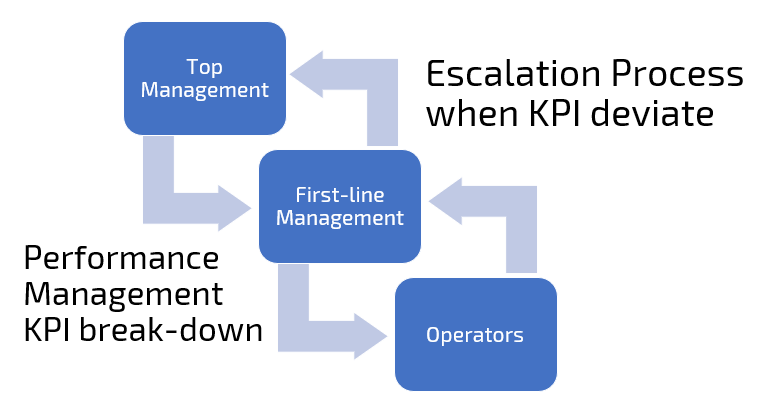
Escalation Upward – Management Decisions
Problems should be escalated to the next management level when they cannot be resolved within the team's responsibility or authority.
For example:
- An Operator identifies a recurring machine problem that requires Maintenance support.
- A Team Leader identifies a staffing issue that requires a Production Manager's decision.
- A Production Manager identifies a capacity limitation that requires investment approval.
A typical escalation structure is:
Operators → First-Line Management → Production Management → Top Management
Each level should resolve the issues within its responsibility and escalate those requiring higher-level decisions.
Escalation Sideways – Cross-Functional Support
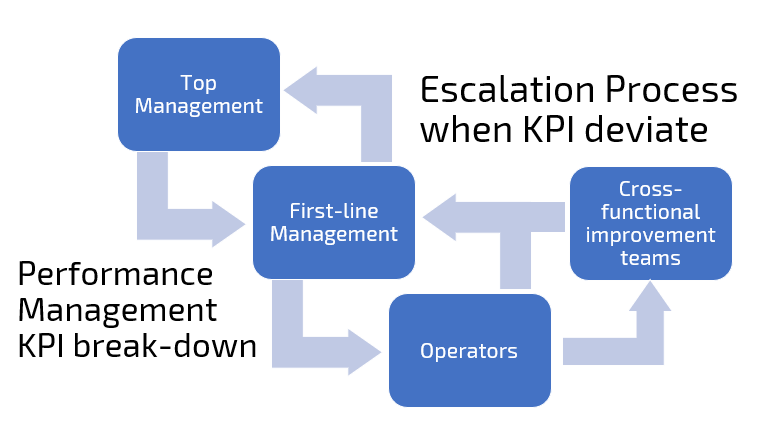
Some problems require collaboration between departments rather than decisions from higher management.
For example:
- Repeated material shortages may require support from Logistics.
- Quality deviations may require investigation by Quality and Engineering.
- Recurring breakdowns may require cooperation between Production and Maintenance.
These issues can be escalated to a cross-functional improvement team.
Such teams bring together the expertise needed to investigate root causes and develop sustainable solutions.
The key principle: Escalation should help solve problems, not simply move responsibility elsewhere.
4. Use Improvement Meetings for Complex Problems
Daily meetings are designed for quick reviews and decisions.
Problems requiring detailed analysis should be handled separately through structured improvement meetings.
These meetings typically involve relevant specialists and may take place weekly or monthly, depending on the organization's needs.
Improvement meetings should focus on:
- Investigating recurring production losses.
- Identifying root causes.
- Evaluating potential solutions.
- Assigning corrective and preventive actions.
- Following up on improvement results.
For example, if a production line experiences repeated short stops, a cross-functional team might investigate equipment settings, material quality, and operating procedures.
The findings can then be used to implement improvements and monitor their effectiveness.
5. Connect Meetings Across Organizational Levels
A tiered meeting structure helps information and decisions flow through the organization.
For example:
| Meeting Level | Typical Frequency | Main Purpose |
|---|---|---|
| Operators and Team Leaders | Daily or per shift | Identify and resolve immediate production problems |
| Production Management | Daily or weekly | Address escalated issues and review production performance |
| Cross-Functional Improvement Teams | Weekly or as needed | Investigate recurring problems and develop solutions |
| Top Management | Weekly or monthly | Address strategic issues and resource requirements |
Whenever possible, schedule first-line meetings before higher-level meetings.
This allows unresolved problems to be escalated quickly, potentially reaching the appropriate decision-maker on the same day.
Urgent safety, quality, or production issues should always be escalated immediately rather than waiting for the next scheduled meeting.
6. Use Good Solutions to Support Performance Management
Good Solutions provides production data and analysis tools that support performance management across organizational levels.
| Good Solutions Function | How It Supports Performance Management |
|---|---|
| Dashboards | Make relevant KPIs, targets, and deviations visible. |
| Timeline | Help teams identify production interruptions and investigate what happened. |
| Reports | Provide detailed analysis of production losses, trends, and improvement results. |
| Operator Tools | Support operational follow-up and accurate production data collection. |
| Scheduled Reports | Distribute relevant production information to stakeholders. |
For example, an Operator may identify repeated stops during a shift.
The Team Leader reviews the interruptions using the Timeline and escalates the problem to Maintenance when specialist support is needed.
A weekly improvement meeting then uses production Reports to investigate recurring patterns and identify corrective actions.
Once improvements are implemented, the team can monitor the results using Dashboards and Reports.
This creates a continuous improvement cycle:
Measure → Identify Deviations → Assign Actions → Escalate When Needed → Improve → Follow Up
Key Success Factors
For performance management and escalation processes to work effectively, organizations need:
- Reliable data: Everyone should base decisions on consistent production information.
- Relevant KPIs: Each organizational level should monitor information it can influence.
- Clear responsibilities: Every problem and action should have an accountable owner.
- Structured meetings: Meetings should have a clear purpose, agenda, and follow-up routine.
- Defined escalation rules: Everyone should understand when and where problems should be escalated.
- A constructive culture: Focus on understanding and solving problems rather than assigning blame.
Key Takeaways
Effective performance management connects organizational goals with daily operational activities.
By combining relevant KPIs, structured meetings, and clear escalation processes, manufacturers can identify problems earlier and ensure they reach the people best equipped to resolve them.
The objective is to solve problems at the lowest appropriate organizational level, escalate efficiently when necessary, and continuously improve production performance.