
Understanding the OEE Time Model
Overall Equipment Effectiveness (OEE) measures how effectively a machine uses its planned production time to produce approved products at the expected speed.
To calculate OEE, we start with the total time available and progressively subtract time that is not scheduled for production, excluded time, and production losses.
The result is the time during which the machine produces approved products at its ideal production speed.
This is often referred to as Value-Adding Time.
The OEE time model helps manufacturers understand not only how efficiently equipment is performing, but also where production capacity is being lost.
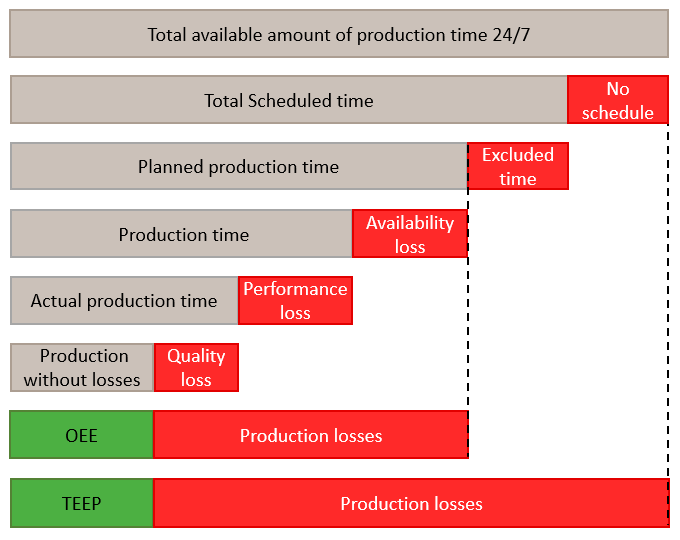
Step 1: Total Available Time
The starting point is the total calendar time available for a machine.
A machine is theoretically available 24 hours per day, 7 days per week, regardless of whether production is scheduled.
For example, over one week:
Total Available Time = 7 × 24 hours = 168 hours
This represents the maximum possible time that the equipment could be used.
However, most factories do not schedule production continuously.
Step 2: Total Scheduled Time
The next step is to subtract periods when the machine is not scheduled to operate.
This is referred to as No Schedule.
Examples include:
- Nights when the factory is closed.
- Weekends without scheduled production.
- Other periods when the machine is not scheduled for use.
The remaining time is called Total Scheduled Time.
For example, if a machine is scheduled for two eight-hour shifts, five days per week:
Total Scheduled Time = 80 hours per week
The remaining 88 hours are classified as No Schedule.
Step 3: Planned Production Time
Not all scheduled time is necessarily intended for production.
Some periods may be explicitly excluded from the OEE calculation, depending on how production schedules are configured.
These periods are referred to as Excluded Time.
Examples may include:
- Scheduled breaks.
- Planned meetings or training.
- Periods when production is deliberately not planned.
- Other activities explicitly excluded from planned production time.
After subtracting Excluded Time from Total Scheduled Time, we arrive at Planned Production Time.
Planned Production Time = Total Scheduled Time − Excluded Time
This is the time used as the basis for calculating OEE.
Why excluded time matters
The definition of Planned Production Time has a significant impact on OEE.
The more time you exclude, the less time remains available for measuring production losses.
This can result in a higher OEE value without any actual improvement in production efficiency.
For this reason, it is important to establish clear and consistent rules for which activities should be excluded.
Our recommendation: Avoid excluding time simply to achieve a higher OEE. Instead, consider which losses you want to understand and improve.
For example, if reducing changeover time is an important improvement objective, changeovers should normally remain within Planned Production Time so that their impact is visible.
The purpose of OEE is not to report the highest possible number, but to identify opportunities to improve production.
Step 4: Availability – How Much Time Was the Machine Running?
Once Planned Production Time has been established, the first type of production loss is Availability Loss.
Availability losses occur when the machine is not producing during planned production time.
Examples include:
- Machine breakdowns.
- Material shortages.
- Changeovers and setup activities.
- Equipment adjustments.
- Other production interruptions.
After subtracting Availability Losses, the remaining time is called Production Time, also commonly referred to as Run Time.
Production Time = Planned Production Time − Availability Losses
Availability is calculated as:
Availability = Production Time / Planned Production Time
What about Micro Stops?
Micro Stops are short production interruptions that may only last a few seconds.
Although they are individually small, frequent Micro Stops can result in significant production losses.
Depending on how production data is collected and calculated, Micro Stops may be recorded as Availability Losses or included in Performance Losses.
In Good Solutions, the important principle is to consistently identify and measure these interruptions so their impact on production is visible.
Tip: Categorizing production stops with the correct reason codes makes it easier to understand why Availability is being lost and where improvement efforts should be focused.
Step 5: Performance – How Efficiently Did the Machine Run?
A machine may be running without producing at its expected speed.
Performance measures how efficiently equipment operates compared with its defined ideal cycle time.
Performance losses occur when production runs slower than expected.
Examples include:
- Reduced operating speed.
- Minor interruptions.
- Worn equipment components.
- Incorrect machine settings.
- Material handling problems.
Performance Loss is the difference between actual Production Time and the ideal time required to produce the recorded output.
After subtracting Performance Losses, the remaining time is called Actual Production Time in the illustrated time model, often referred to as Net Production Time.
Net Production Time = Production Time − Performance Losses
Performance is calculated as:
Performance = Net Production Time / Production Time
For example, if a machine runs for 60 minutes but produces an amount that should take 48 minutes at its ideal speed, Performance is 80%.
The remaining 12 minutes represent equivalent Performance Loss.
Step 6: Quality – How Much Production Was Approved?
The final component is Quality.
Quality measures the proportion of production that meets the required quality standards.
Quality losses occur when products are rejected or require additional processing.
Examples include:
- Scrap.
- Defective products.
- Rework.
- Products that fail quality inspections.
Rework occurs when a product requires additional processing to meet the required quality standard.
How rework affects Quality depends on the production process and the calculation rules used.
Quality losses can be expressed as equivalent production time using the ideal cycle time.
After subtracting Quality Losses, the remaining time represents Production Without Losses, also referred to as Value-Adding Time.
Value-Adding Time = Net Production Time − Quality Losses
Quality is calculated as:
Quality = Good Production / Total Production
This represents the proportion of production that meets the required quality standard.
Step 7: Calculating OEE
Once Availability, Performance, and Quality have been calculated, they are combined to determine OEE.
OEE = Availability × Performance × Quality
OEE can also be expressed using the time model:
OEE = Value-Adding Time / Planned Production Time
For example, imagine a machine with the following results:
| Time Category | Hours |
|---|---|
| Planned Production Time | 40 |
| Availability Losses | 6 |
| Production Time | 34 |
| Performance Losses | 4 |
| Net Production Time | 30 |
| Quality Losses | 2 |
| Value-Adding Time | 28 |
The resulting OEE is:
OEE = 28 / 40 = 70%
This means that 70% of planned production time was effectively used to produce approved products at the ideal production speed.
The remaining 30% represents losses from Availability, Performance, and Quality.
Understanding TEEP
While OEE measures effectiveness during Planned Production Time, TEEP (Total Effective Equipment Performance) measures effectiveness against all available calendar time.
This includes periods when production is not scheduled.
TEEP is calculated as:
TEEP = Value-Adding Time / Total Available Time
For example, if a machine has 168 hours of Total Available Time during a week but only achieves 28 hours of Value-Adding Time:
TEEP = 28 / 168 = 16.7%
This does not necessarily mean that the machine is performing poorly.
It may simply mean that the machine is only scheduled to operate during a small portion of the week.
TEEP is particularly useful when evaluating:
- Overall equipment capacity utilization.
- Opportunities to increase production without investing in new equipment.
- Whether additional shifts could increase output.
- Long-term capacity planning and investment decisions.
In short: OEE helps you understand how effectively you use your planned production time, while TEEP helps you understand how effectively you use your total available equipment capacity.
Why the Time Model Matters
The OEE time model provides a structured way to understand how production capacity is used and lost.
It helps answer important operational questions:
- How much time is actually scheduled for production?
- How much time is excluded from the OEE calculation?
- How much production time is lost due to stops?
- How much capacity is lost because machines run below their ideal speed?
- How much production capacity is lost due to quality problems?
- How much additional capacity could be available through improved scheduling or production efficiency?
By understanding these relationships, manufacturers can distinguish between different improvement opportunities.
For example, increasing the number of scheduled production hours may improve overall equipment utilization, while reducing breakdowns, speed losses, or quality problems improves OEE.
Both approaches can increase production capacity, but they address different types of losses.
Using the Time Model in Good Solutions
Good Solutions uses production schedules, machine activity, production quantities, and quality information to calculate and analyse production effectiveness.
By defining production schedules and recording production losses accurately, you create the foundation for reliable OEE reporting.
To get the most value from the time model:
- Maintain accurate production schedules: Ensure scheduled production time reflects your intended operations.
- Use consistent rules for Excluded Time: Avoid excluding losses that you want to monitor and improve.
- Categorize production stops: Assign relevant stop reasons to understand Availability Losses.
- Maintain accurate cycle times: Ensure ideal production speeds reflect the expected performance of your equipment.
- Record quality losses: Capture scrap and rework to understand their impact on production.
- Review losses regularly: Use the Timeline and Reports to identify improvement opportunities.
The ultimate purpose of the time model is not simply to calculate OEE, but to make production losses visible, understandable, and actionable.